Spider-Man vs. Venom — A Rivalry Forged in Rejection, Obsession, and Identity

The rivalry between Spider-Man and Venom stands as one of the most emotionally charged and narratively rich conflicts in comic book history. It is not simply a clash between hero and villain, but a deeply personal war rooted in rejection, resentment, and a shared origin that binds them together in ways neither can fully escape. Over decades of storytelling, their relationship has evolved from pure antagonism into something far more complex—part rivalry, part reflection, and at times, an uneasy alliance shaped by circumstance.
The Origin of the Symbiote: A Bond Gone Wrong

The foundation of the Spider-Man vs. Venom rivalry begins during Secret Wars, a cosmic crossover that dramatically altered the trajectory of Spider-Man’s mythos. Transported to Battleworld, Peter Parker encounters an alien organism that he mistakenly believes to be a technologically advanced costume. The black suit enhances his abilities in ways that feel almost intoxicating—his strength increases, his agility sharpens, and he no longer needs to rely on mechanical web-shooters.
At first, the suit seems like a gift. But what makes this origin so compelling is the slow realization that the symbiote is not an object, but a living entity with its own will. It bonds with Peter not just physically, but emotionally, feeding off his stress and aggression. Over time, Peter notices changes in himself—he becomes more irritable, more exhausted, and more prone to anger.
The turning point comes when Peter discovers the truth. In a desperate attempt to free himself, he exploits the symbiote’s vulnerability to intense sound, using the ringing bells of a church to separate from it. This moment is one of the most iconic in Spider-Man history, not just for its visual symbolism, but for what it represents. Peter rejects power because it compromises who he is. He chooses responsibility over strength.
For the symbiote, however, this is not a heroic decision. It is abandonment.
Eddie Brock: The Human Half of Venom

The symbiote’s pain and anger find a perfect counterpart in Eddie Brock, a journalist whose life has unraveled in large part because of Spider-Man. Brock had built his reputation on a story that ultimately proved to be false, and when Spider-Man exposed the truth, Brock’s career collapsed. His fall from grace leaves him bitter, humiliated, and desperate for someone to blame.
What makes the creation of Venom so effective is the alignment of two separate vendettas. The symbiote hates Peter Parker for rejecting it. Eddie Brock hates Spider-Man for ruining his life. When the two encounter each other in the same church where Peter severed the bond, their union feels almost inevitable.
Together, they become Venom—a being defined not just by power, but by shared hatred.

This fusion creates one of Spider-Man’s most dangerous enemies for several reasons. Venom possesses all of Spider-Man’s abilities, amplified by brute strength and an unpredictable, shape-shifting physiology. More importantly, because the symbiote retains Peter’s memories, Venom knows Spider-Man’s secret identity. He knows about Aunt May, about Mary Jane, about every vulnerability Peter has tried to protect.
Perhaps most terrifying of all, Venom is invisible to Spider-Man’s spider-sense. The very ability that has kept Peter alive countless times offers him no warning against this enemy. It is as if Venom exists outside the rules that normally govern Spider-Man’s world.
An Intense Rivalry
What elevates this Spider-Man vs. Venom rivalry beyond typical superhero conflicts is the intensely personal nature of their connection. Spider-Man is not fighting a stranger or even a traditional villain. He is confronting something that once chose him, bonded with him, and was ultimately cast aside.
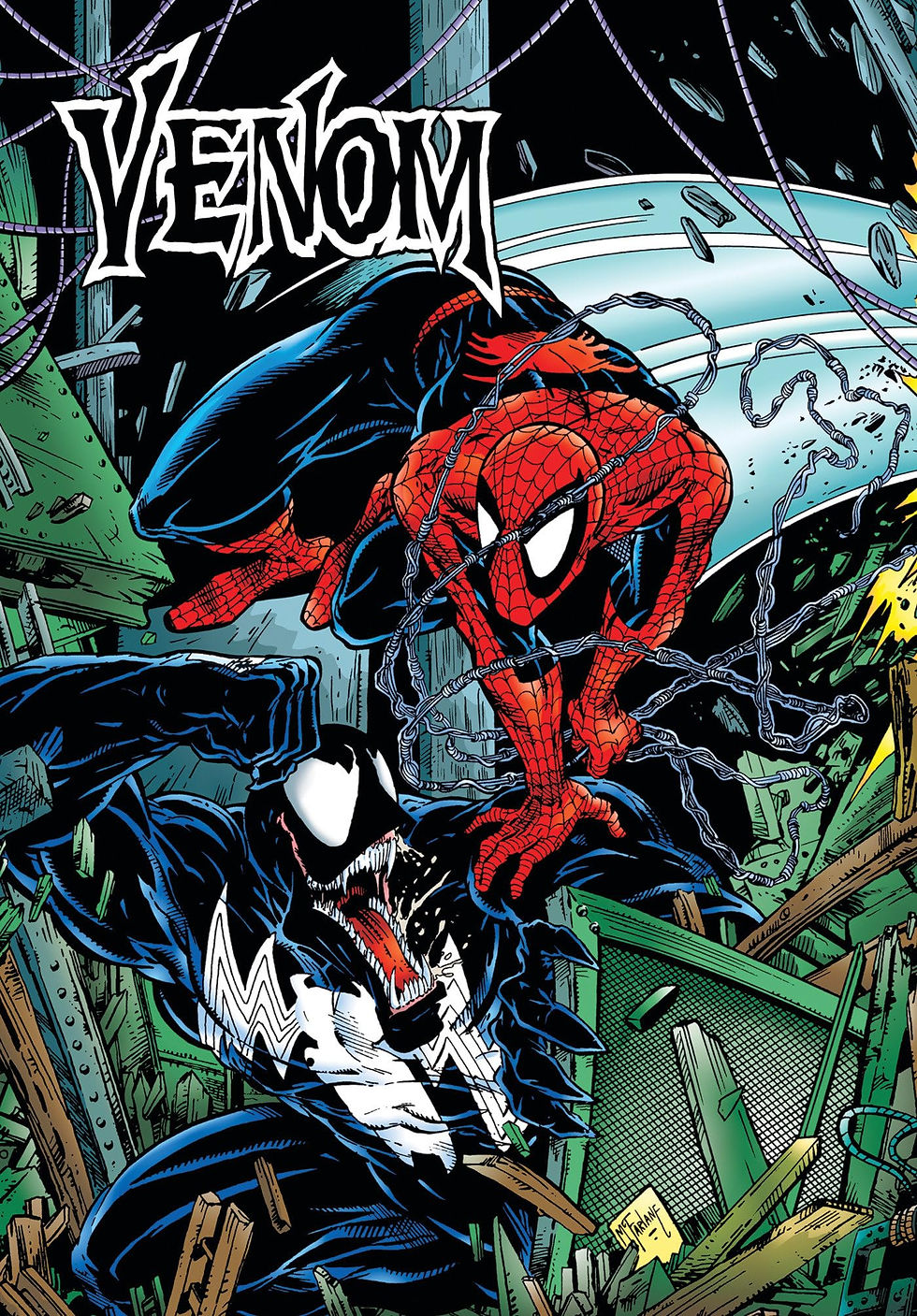
For Venom, this rejection is not something that can be rationalized. The symbiote does not understand Peter’s moral reasoning. It only understands that it was abandoned. Eddie Brock, meanwhile, channels his own failures into a singular obsession with destroying Spider-Man. Together, they reinforce each other’s anger, creating a feedback loop of resentment that fuels every encounter.
This dynamic transforms their battles into more than physical confrontations. Each fight is layered with psychological tension. Venom taunts Peter with knowledge of his personal life, forcing him to defend not just himself, but the people he loves. Peter, in turn, is forced to grapple with the guilt of having created this enemy, even if unintentionally.
Venom is not just a villain. He is a consequence.
Defining Battles and Storylines
The Spider-Man vs. Venom rivalry is crystallized in Amazing Spider-Man number 300, a landmark issue that introduces Venom in full. Their first major confrontation establishes the tone for everything that follows. Spider-Man quickly realizes that he is outmatched in raw power and must rely on strategy and ingenuity to survive. The fight is tense, brutal, and deeply unsettling, particularly as Venom demonstrates his knowledge of Peter’s identity.

Subsequent encounters often return to the imagery of their shared origin. Churches, bells, and confined spaces become recurring backdrops, reinforcing the symbolic weight of their connection. These battles are rarely straightforward victories. Spider-Man must constantly adapt, exploiting Venom’s weaknesses to sound and fire while avoiding his overwhelming strength.
The crossover event Maximum Carnage adds another dimension to their relationship by forcing them into an uneasy alliance against Carnage, a villain who represents an even more unrestrained form of chaos. In this storyline, Spider-Man and Venom’s differences are thrown into sharp relief. While they share a common enemy, their methods and moral boundaries remain fundamentally opposed.
Evolution Over Time
As comic book storytelling has evolved, so too has the relationship between Spider-Man and Venom. What began as a straightforward hero-versus-villain dynamic has grown increasingly nuanced.
Venom’s transition into an anti-hero during the early 1990s marked a significant shift. Eddie Brock develops a warped sense of justice, targeting those he deems deserving of punishment while maintaining his vendetta against Spider-Man. This change complicates their interactions, as Venom is no longer purely destructive, but still operates outside the boundaries Spider-Man refuses to cross.

The introduction of new hosts further reshapes the character. When Flash Thompson becomes Agent Venom, the symbiote is recontextualized as a tool for heroism rather than vengeance. This period demonstrates that the symbiote itself is not inherently evil, but influenced by the host it bonds with.
More recent storylines expand the mythology of the symbiotes into cosmic territory, introducing entities like Knull, the god of symbiotes. These developments elevate Venom’s significance within the Marvel Universe, but they also reinforce the importance of his origin with Spider-Man. No matter how large the story becomes, the emotional core of Venom’s character remains tied to Peter Parker.
Legacy and Cultural Impact
At its heart, the Spider-Man vs. Venom rivalry is a story about identity and choice. Spider-Man represents discipline, responsibility, and the constant struggle to do the right thing despite personal hardship. Venom represents what happens when those same hardships are allowed to fester into anger and obsession.
The symbiote amplifies what is already present in its host. In Peter, it heightened aggression that he ultimately rejected. In Eddie, it found a perfect partner for its rage. This contrast underscores one of the central themes of Spider-Man’s character: power alone does not define a hero. It is the choices made with that power that matter.
This is why their rivalry continues to resonate. It is not just about who wins a fight, but about what each character represents.
The impact of this rivalry extends far beyond the pages of comics. It has been adapted across multiple forms of media, each interpretation reinforcing the core elements that make it so compelling. Animated series, films, and video games have all explored the tension between Spider-Man and Venom, often highlighting the personal stakes that define their conflict.
From the haunting imagery of the black suit to the monstrous presence of Venom himself, the visual and thematic elements of their rivalry have become iconic. Even for those unfamiliar with the comics, the contrast between the two characters is instantly recognizable.

Spider-Man vs. Venom: A Rivalry That Endures
The enduring power of Spider-Man vs. Venom lies in its emotional depth. This is not a rivalry born of coincidence or ideology, but of shared history and mutual resentment. Venom is, in many ways, the shadow of Spider-Man—a reminder of what he could have become under different circumstances.
Every confrontation between them carries that weight. Every battle is a reflection of the choices that define them.
In a universe filled with cosmic threats and world-ending stakes, the story of Spider-Man and Venom remains grounded in something far more relatable: the consequences of rejection, the danger of unchecked anger, and the constant struggle to choose who you want to be.
And that is what makes it one of the greatest rivalries in comic book history.


Comments