The Clone Saga: Marvel’s Most Infamous Spider-Man Epic
- Mark’s Shelf Space Collectibles
- Apr 4
- 7 min read


If you were reading Spider-Man comics in the 1990s, chances are you either loved—or survived—the Clone Saga. Spanning multiple titles like Amazing Spider-Man, Spectacular Spider-Man, Web of Spider-Man, and Spider-Man, this massive crossover became one of the most controversial storylines in comic book history. But beneath the chaos, retcons, and editorial overreach lies a fascinating narrative experiment that reshaped Spider-Man lore forever.
Let’s break it down.
The Core Premise: Who Is the Real Spider-Man?
The Clone Saga builds on a concept first introduced in the 1970s: what if Peter Parker had a clone?
Enter Ben Reilly, a genetically identical copy of Peter Parker created by the Jackal. Believed dead for years, Ben returns to New York during the 90s storyline—and that’s when everything gets wild.
The biggest twist? Marvel reveals that Ben might actually be the real Peter Parker, and the Peter we’ve followed for decades could be the clone.
Yes, really.
This revelation flips the entire Spider-Man mythos on its head. Peter, now questioning his identity, considers stepping away from being Spider-Man, especially as he prepares for fatherhood with Mary Jane.
The Key Players
The Jackal (Miles Warren)

The mad scientist behind the cloning experiments, Jackal is obsessed with Gwen Stacy and driven by grief and madness. His experiments kick off the entire saga.
Ben Reilly / Scarlet Spider

Ben takes on the identity of the Scarlet Spider, sporting a hoodie and sleeveless suit that became iconic. He represents a “what if” version of Peter—same morals, different life.
Kaine

A failed clone of Peter, Kaine is scarred, unstable, and dangerous. He adds a darker edge to the story and serves as both antagonist and tragic figure.
Norman Osborn (The Green Goblin)

In a late-stage twist, Green Goblin is revealed to have orchestrated much of the Clone Saga from behind the scenes—retconning years of presumed death.
The Scope (and Problem) of the Clone Saga
What started as a tight, emotional story ballooned into a sprawling event across four ongoing titles. Editorial decisions stretched the storyline far beyond its original intent.
Instead of a concise arc, readers got dozens of interconnected issues, repetitive plot beats, confusing continuity, and multiple fake-out deaths and reversals. The Clone Saga became a textbook example of event fatigue—where a story overstays its welcome due to commercial success.
Themes Beneath the Chaos
Despite its reputation, the Clone Saga explores some genuinely compelling ideas.
Identity and Self-Worth
What defines a person? Memories? Experiences? DNA?Peter and Ben both struggle with these questions, making their conflict deeply philosophical.
Legacy
With Peter considering retirement, the idea of Spider-Man as a mantle—not just a person—comes into play.
Responsibility
Even if Ben is “just a clone,” he still lives by the mantra: With great power comes great responsibility.
Lasting Impact on Spider-Man
Love it or hate it, the Clone Saga left a permanent mark on Spider-Man comics and it reshaped how Marvel approached storytelling, continuity, and even fan expectations for years to come. While the storyline itself may have been controversial, its ripple effects are undeniable, both within the Spider-Man mythos and across the broader comic book industry.
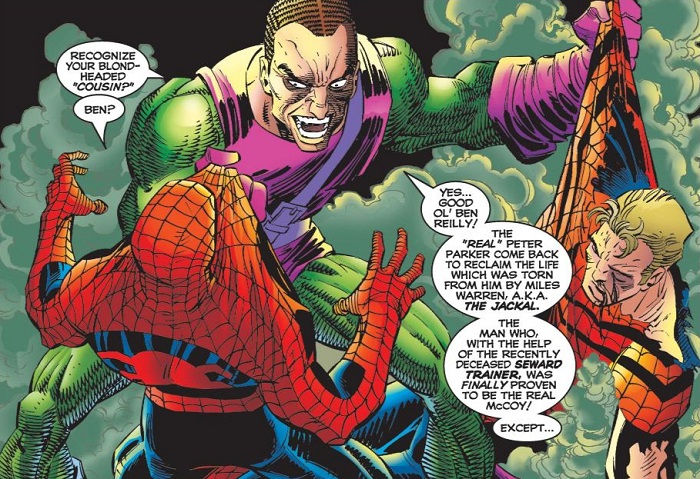
Perhaps the most immediate and lasting impact was the unexpected endurance of Ben Reilly. Originally positioned as a temporary or transitional character, Ben evolved into something much more significant. Despite initial resistance from fans who were deeply attached to Peter Parker, Ben’s sincerity, internal conflict, and distinct life experiences gradually earned him a loyal following. Marvel recognized this over time, bringing him back repeatedly in later years—not just as a nostalgic callback, but as a fully realized character capable of carrying his own stories. His return in modern comics, including runs where he again dons the Spider-Man identity, demonstrates how a character born from a divisive storyline can ultimately become a cornerstone of the mythos.
Similarly, Kaine represents one of the saga’s most successful long-term transformations. Initially introduced as a violent, unstable antagonist, Kaine was later reimagined as a complex antihero, even taking on the Scarlet Spider mantle in his own series. His evolution reflects a broader trend in comics toward morally gray characters, but it also highlights how the Clone Saga planted seeds that writers would cultivate years later with far greater narrative focus and clarity.

Beyond individual characters, the Clone Saga cemented cloning as a recurring thematic and narrative device in Spider-Man stories. The idea that identity can be duplicated, fractured, or manipulated has resurfaced in numerous arcs since the 1990s. Whether through literal clones or more metaphorical explorations of identity, the saga expanded the conceptual boundaries of what a Spider-Man story could be. It challenged the notion that Peter Parker was singular and irreplaceable—while ultimately reaffirming that he shouldn’t be replaced.
On a structural level, the Clone Saga had a profound influence on Marvel’s editorial philosophy. The backlash it generated served as a wake-up call about the dangers of overextending a storyline. In the years that followed, Marvel became more cautious about sprawling, open-ended crossover events—at least for a time—placing greater emphasis on tighter storytelling and clearer narrative direction. The saga became a kind of internal case study: a reminder that even the most compelling premise can collapse under the weight of excessive serialization and shifting creative mandates.
It also changed how fans engaged with continuity. Readers became more skeptical of major status quo changes, particularly those involving identity swaps, deaths, or retcons. When Marvel later introduced controversial developments—whether in Spider-Man or other franchises—there was often an undercurrent of “Clone Saga PTSD” among longtime fans. In this way, the storyline didn’t just impact Spider-Man—it reshaped the relationship between Marvel and its audience, fostering a more critical and continuity-aware readership.

At the same time, the Clone Saga reinforced something fundamental about Spider-Man as a character: the centrality of Peter Parker. The attempt to position Ben Reilly as the “true” Spider-Man ultimately underscored how deeply readers were invested in Peter’s journey. His history, his relationships, and his personal struggles couldn’t simply be transferred to another character, even one with identical DNA. Marvel’s eventual decision to restore Peter as the definitive Spider-Man wasn’t just a narrative correction—it was an acknowledgment of what the character represents to generations of fans.
In the decades since, Marvel has revisited elements of the Clone Saga with a more measured approach. Writers have mined its concepts for new stories, often refining or recontextualizing ideas that were originally lost in the chaos. This kind of creative recycling has allowed the saga to achieve a sort of redemption—not by rewriting its history, but by building on its strongest components.
Ultimately, the Clone Saga’s legacy is one of contradiction. It is both a warning and a wellspring of creativity, a story that stumbled in execution but succeeded in expanding the possibilities of Spider-Man’s world. Its impact endures not because it was flawless, but because it dared to take risks—and in doing so, changed the trajectory of one of comics’ most iconic heroes.
Critical Reception: Then vs. Now
When the Clone Saga was unfolding in real time during the mid-1990s, reader frustration built gradually and then all at once. At first, there was genuine intrigue. The return of a long-forgotten concept from the 1970s, combined with the emotional weight of Peter Parker potentially stepping away from the Spider-Man mantle, created a sense that Marvel was attempting something bold—maybe even historic. Early issues featuring Ben Reilly as the Scarlet Spider were met with curiosity and, in some corners, excitement. Fans were open to the idea that Spider-Man could evolve.
But that goodwill eroded as the storyline stretched on far beyond its natural conclusion. What was initially intended to be a relatively contained arc reportedly expanded due to strong sales and editorial pressure, and readers began to feel the effects. Plotlines that seemed meaningful were repeatedly undone. Revelations lost their impact because they were often reversed within months. The question of who the “real” Peter Parker was—initially a shocking and emotionally charged twist—became a source of fatigue rather than tension. Instead of deepening the story, each new development risked making the narrative feel less stable and less trustworthy.

A major point of criticism centered on the erosion of emotional stakes. Deaths, long considered one of the most powerful storytelling tools in comics, became suspect. When Aunt May “died,” it carried enormous weight—only for that moment to be retroactively undercut by the revelation that it wasn’t truly her. Similarly, the return of Green Goblin, long believed dead since one of the most defining moments in Spider-Man history, was seen by many as a step too far. For longtime readers, these reversals didn’t just complicate continuity—they weakened the sense that actions in the story had lasting consequences.
Critics at the time, including comic reviewers and fan publications, increasingly described the saga as convoluted and editorially driven rather than character-driven. The narrative began to feel like it was chasing shock value instead of earning it. With four monthly Spider-Man titles all required to participate, the story became fragmented, forcing readers to follow multiple series just to keep up. This not only made the saga less accessible but also amplified its pacing issues, as similar beats and themes repeated across books.

However, time has a way of softening even the most divisive storylines. In retrospect, the Clone Saga is often reassessed with a more nuanced perspective. While its structural problems remain undeniable, many fans now separate the core ideas from their execution. The philosophical questions about identity—what makes Peter Parker Peter Parker—are now seen as some of the most ambitious themes ever explored in a mainstream Spider-Man story. The relationship between Peter and Ben, in particular, has gained appreciation for its emotional depth, especially in moments where the two characters recognize themselves in each other.
Additionally, characters introduced or elevated during the saga have enjoyed lasting popularity. Ben Reilly, once rejected by a portion of the fanbase, has since become a fan-favorite figure, returning in multiple modern storylines and even taking on the Spider-Man mantle again in recent years. Likewise, Kaine has been reimagined as a compelling antihero, further validating the creative potential buried within the original saga.
Today, the Clone Saga is often viewed less as a failure and more as a cautionary tale—an example of what happens when strong ideas are stretched beyond their limits. It represents both the risks and rewards of serialized storytelling in superhero comics. While its execution may have faltered, its ambition and long-term influence ensure that it remains one of the most talked-about chapters in Spider-Man history.

Final Verdict
The Clone Saga is messy, ambitious, frustrating—and undeniably important.
It’s a story that tried to redefine Spider-Man and ended up redefining how not to run a crossover event. But within its tangled web lies a bold exploration of identity, legacy, and what it truly means to be Spider-Man.
If you’re a fan of comic book history, it’s essential reading—not because it’s perfect, but because it dared to take a risk.
And in comics, sometimes the biggest swings leave the deepest impact.


Comments